Lithium Batteries
Low-Dew-Point Dry Rooms for Lithium-Ion Batteries: A Design Guide
By SORPS Engineering Team
28 Jun 2026
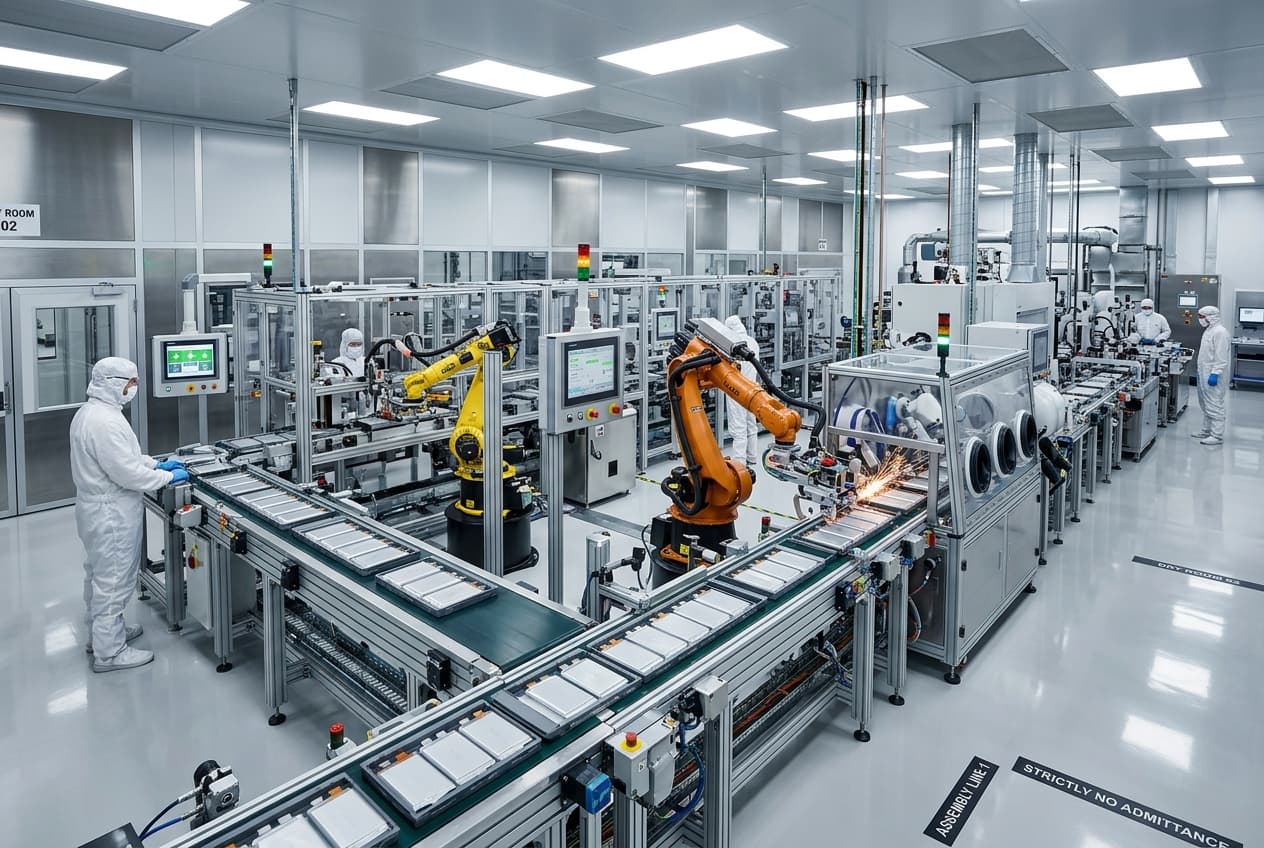
Lithium-ion cell production needs some of the driest air in industry. The electrolyte salt used in most cells (LiPF₆) reacts with even traces of water to form hydrofluoric acid (HF), which damages the cell and reduces its life and safety. Electrode drying, cell assembly and especially electrolyte filling are therefore done in dry rooms. This guide explains how to design one.
Typical design targets
- Supply-air dew point: usually between -40°C and -60°C, depending on the process step. Electrolyte filling is normally the most demanding.
- SORPS systems: deliver supply air down to -40°C dew point.
- What that means: a dew point of -50°C at 20°C room temperature is well below 1% RH.
- Stability: the dew point must hold during shifts, door openings and material transfers, not only in an empty room.
Where the moisture comes from
- People: often the largest load. Each operator adds moisture through breathing and skin, so limit occupancy, use dry-room garments and plan the load per person carefully.
- Infiltration: door openings, gaps in the envelope and pass-through hatches.
- Materials and equipment brought into the room.
- Permeation through walls, floors and seals that are not vapour-tight.
System design
- Pre-cooling: cools and dries the incoming air before the desiccant stage.
- Two-stage drying for the lowest dew points: a first rotor removes most of the moisture, and a second high-performance rotor (often molecular sieve) does the deep drying. For moderate targets a single rotor with a purge sector can be enough.
- Purge sector: cools the rotor after reactivation and recovers heat, which improves the dew point and lowers reactivation energy.
- Reactivation heat: deep-drying rotors need higher reactivation temperatures than standard silica gel. Electric or other high-temperature heat sources are typical; low-pressure steam on its own is usually not hot enough.
- Air recirculation: recirculate most of the room air and bring in only the fresh air needed for people and room pressurisation.
- Post-cooling: brings the hot dry air back to the room temperature.
Room construction
- Leak-tight, vapour-tight walls, ceilings and floors, with sealed joints and penetrations.
- Airlocks at every entry and positive room pressure.
- Avoid materials that absorb and release moisture.
- Dew point sensors in each room, with alarms and data logging.
What to specify: checklist
- Process steps and the dew point needed in each room.
- Room volumes and layout, including airlocks.
- Number of operators per shift.
- Door openings and material transfer frequency.
- Fresh-air quantity and pressurisation.
- Heat loads from process equipment.
- Outdoor design conditions for your city.
- Available reactivation energy source.
Planning a dry room? Contact our engineering team for a moisture load calculation and system proposal.